flux Web3 wallet

flux Web3 wallet

flux Web3 wallet

flux Web3 wallet

Flux is a Web3 wallet design that rethinks how crypto apps handle security onboarding. The MVP is a progressive security system that scales with the user's actual financial risk.

Role

UXUI / Product Design

Focus

UX research, UX/UI design, AI image generation, DeFi Education

Scope

App onboarding to first purchase

tools

Figma, Midjourney
AT A GLANCE – The 6 moves that define this redesign

AT A GLANCE – The 6 moves that define this redesign

AT A GLANCE – The 6 moves that define this redesign

Stratagy

Stratagy

01

01

01

Designing for behavior, emotion, and progression

I designed the experience around how users actually think and feel over time, using progressive disclosure, behavioral triggers, and revealing seed phrase complexity only when needed, guiding actions through subtle triggers, and specific UI decisions.

UX Research

UX Research

02

02

02

Researching patterns behind user decisions

I combined platform audits with real user interview to identify recurring friction and blind spots. Beyond usability issues, I focused on where users feel lost, anxious, or overconfident, and used those insights to shape clearer, more supportive flows.

UI & branding

UI & branding

03

03

03

Crafting a cohesive, modern visual system

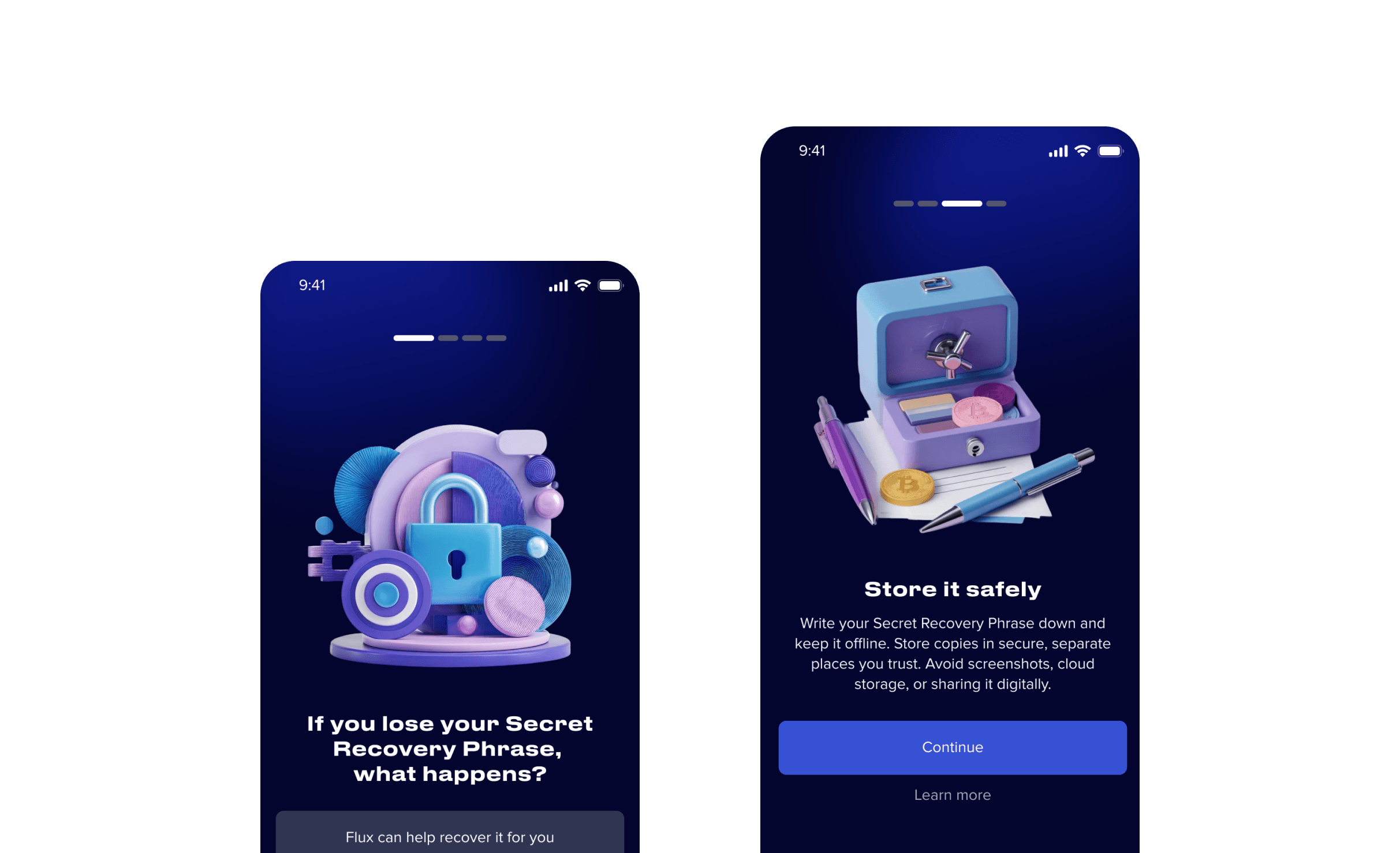
Designing a visual system that's modern and playful. Flux’s branding conveys clarity, trust, and approachability. With a custom logo, dark mode mobile first screens, consistent AI-generated 3D illustrations – creating a distinct, cohesive visual identity across the product.

Constrains

Constrains

04

04

04

Making Web3 concepts clear and usable

The product is grounded in real Web3 constraints — self-custody, security trade-offs…etc. I use interactive quizzes to turn concepts like wallets and private keys into flows that feel less intimidating, helping users navigate Web3 without needing deep technical knowledge.

00 – the problem

It all sounds simple until you try

Decentralized finance is built on something I really believe in — ownership, transparency, no middle layer. But the actual experience don't always feel so positive. Complex wallet setups and unclear custody moments make it hard for first-timers to understand what they own and control. and what self-custody actually means.

82%
82%
82%

found wallet setup the most confusing step

found wallet setup the most confusing step

73%
73%
73%

of new users abandon wallet setup at the seed phrase step

of new users abandon wallet setup at the seed phrase step

of new users abandon wallet setup at the seed phrase step

60%
60%
60%

of 2025–26 crypto theft targeted individual wallets, not protocols

of 2025–26 crypto theft targeted individual wallets, not protocols

of 2025–26 crypto theft targeted individual wallets, not protocols

01 – Research

Every wallet falls into one of two traps

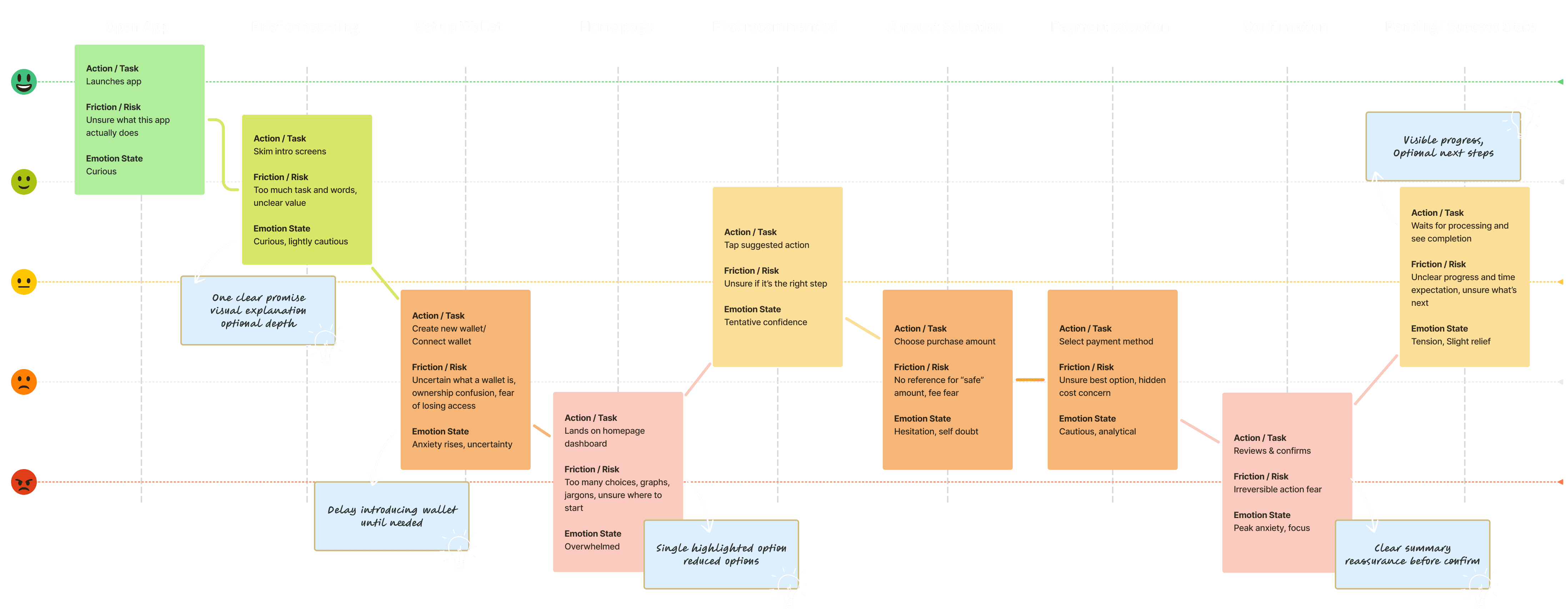
I combined competitive analysis and user research—reviewing apps, forums, and interviews with crypto beginners—to map their emotional journey and identify key friction points and unmet needs.

Key insights that emerged include:


1. Early wallet setup creates friction.
2. Users want to experience value before taking custody.
3. Unclear ownership signals reduce drop-offs.
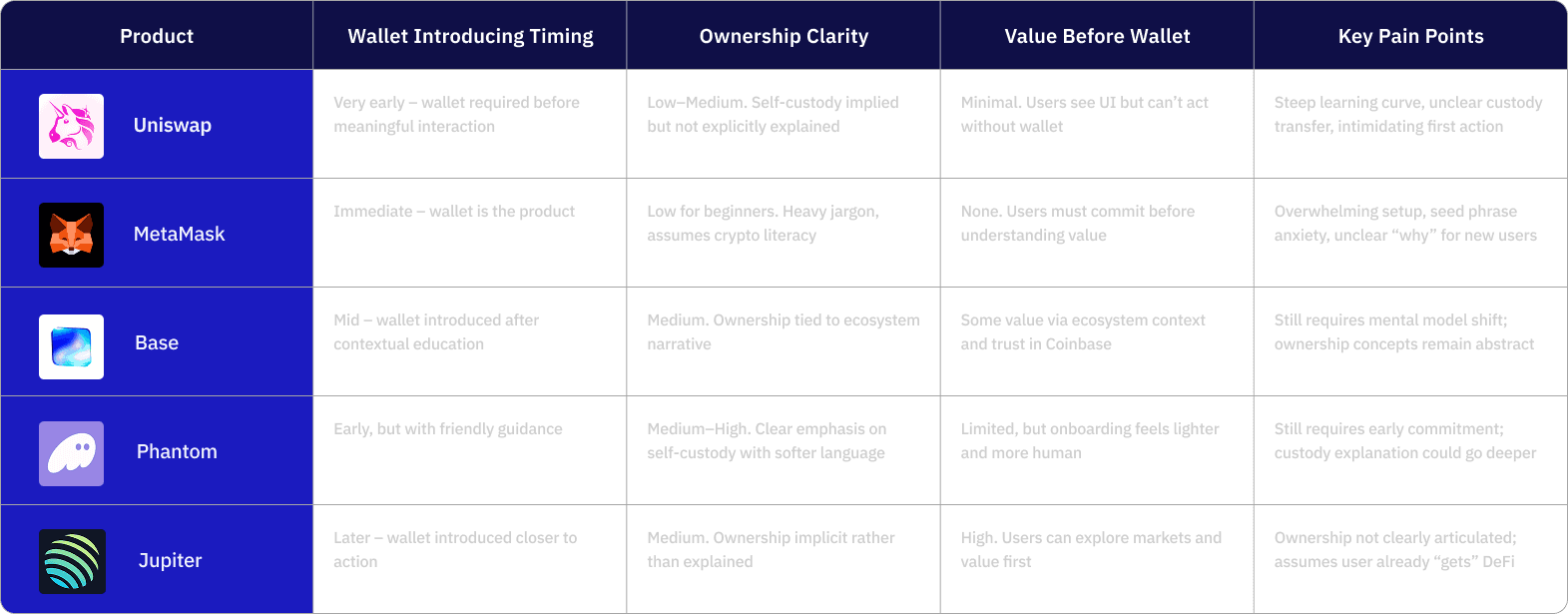
I then analyzed 5 Web3 platforms — Base, Uniswap, MetaMask, Phantom, and Jupiter, — focusing on wallet setup, security education timing, and ownership clarity to find patterns.

Pattern A: The gate keeper

Force seed phrase memorization and quizzes before the user has done anything. MetaMask, Trust Wallet do this. Users quit before seeing any value.

Pattern B: The silent custodian

Let users buy instantly but never surface backup urgency. Base, Uniswap do this. Users lose access when they switch phones. I experienced this firsthand.

02 – user profile & emotional patterns

The people de-fi trading keep losing

I focused on one archetypes from my analysis – The curious newcomer that are scared of doing something irreversible they don't understand, and need to see value before committing to complexity. Understand what they own in plain language.
03 – Design concept

Pattern C: security that grows with you

Instead of choosing between "gate everything" and "gate nothing," the decision is made to be progressive security model where each layer activates based on how much the user has at stake.

There will be 3 stages of security layers.The wallet starts protected by passkey/cloud backup at Level 0. The seed phrase is an upgrade to full self-custody, rather than a prerequisite.

Level 1

Notifying banner after first purchase

Notifying banner after first purchase

Notifying banner after first purchase

Non-blocking notifying banner prompting you to secure wallet right after first buy, with "I'll do this later" as an option.

Non-blocking notifying banner prompting you to secure wallet right after first buy, with "I'll do this later" as an option.

Level 2

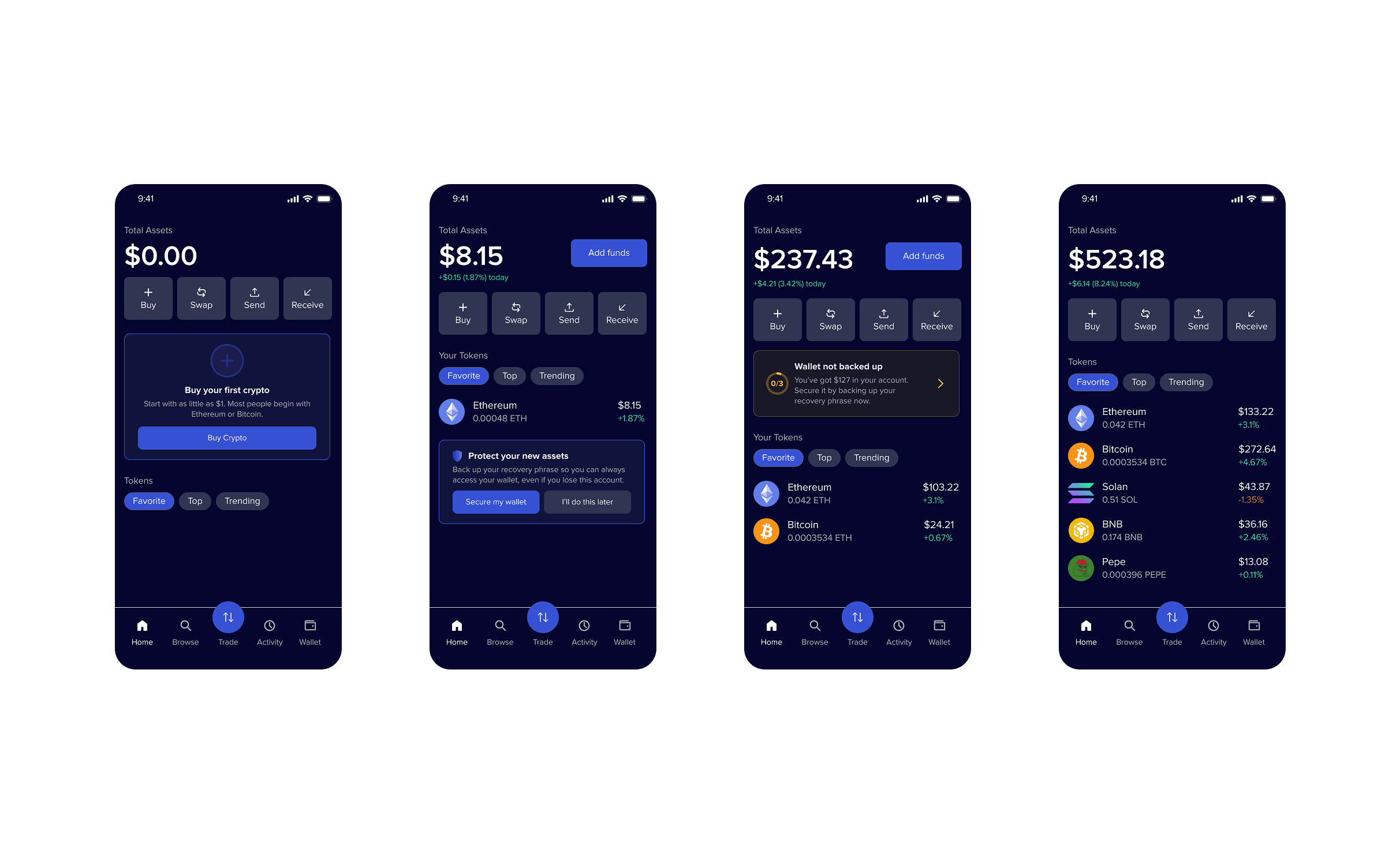
Persistent banner when Balance > $50

Persistent banner when Balance > $50

Persistent banner when Balance > $50

Home screen appear "Wallet not backed up" with a 0/3 progress ring. Stays until done with option to delay it.

Home screen appear "Wallet not backed up" with a 0/3 progress ring. Stays until done with option to delay it.

Level 3

Security gate when Balance > $500

Security gate when Balance > $500

Security gate when Balance > $500

Completely blocks send/swap until recovery phrase is saved. Shows exact dollar amount at risk.

Completely blocks send/swap until recovery phrase is saved. Shows exact dollar amount at risk.

04 – branding & UI

Designing Flux's personality
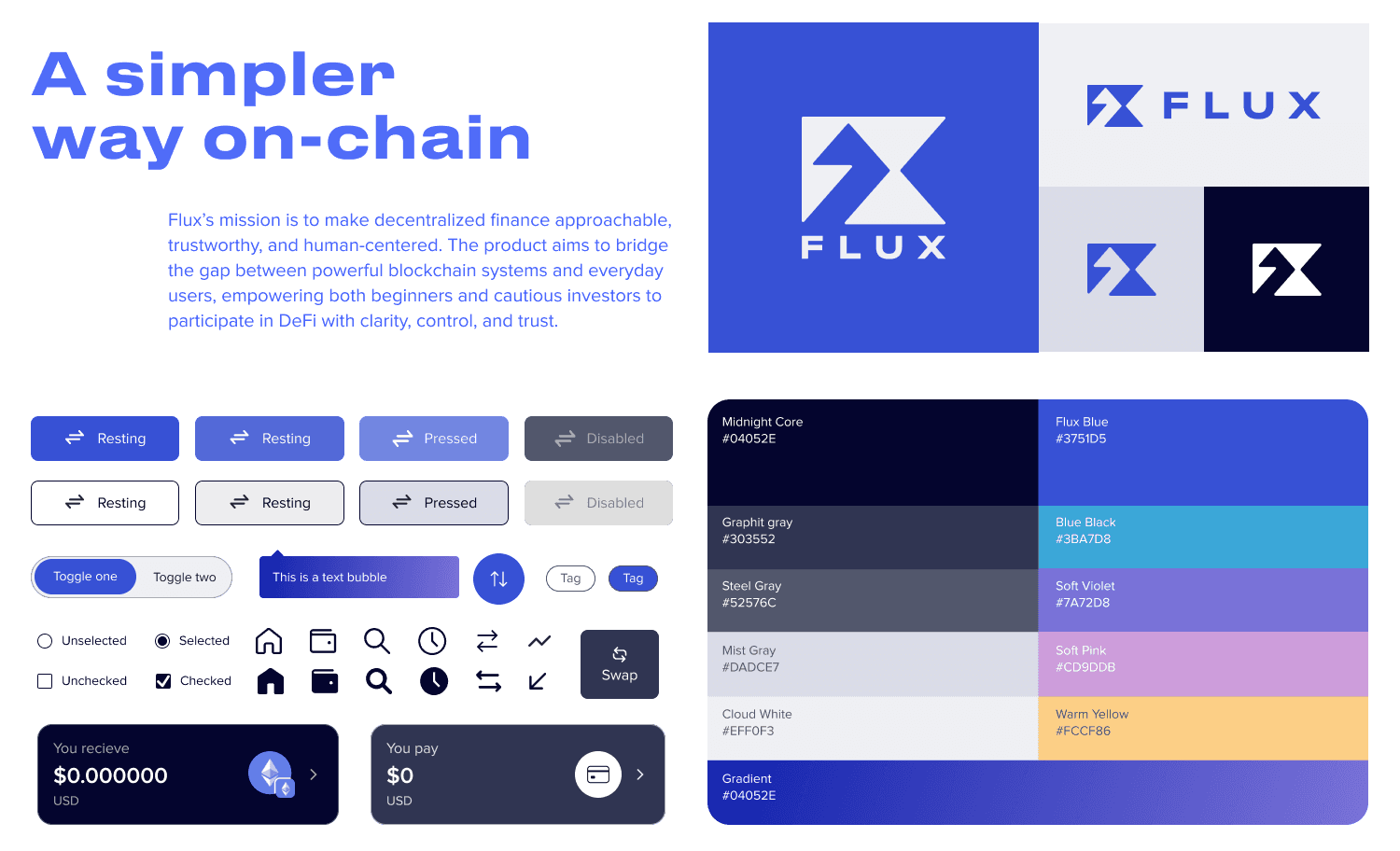
Flux’s branding conveys clarity, trust, and approachability. The upward-arrow logo symbolizes growth, the blue palette evokes calm, and pastel accents soften the tone. Playful 3D illustrations make onboarding concepts tangible and friendly, while a bold, condensed sans-serif typeface adds strength and confidence.


Flux’s branding conveys clarity, trust, and approachability. The upward-arrow logo symbolizes growth, the blue palette evokes calm, and pastel accents soften the tone. Playful 3D illustrations make onboarding concepts tangible and friendly, while a bold, condensed sans-serif typeface adds strength and confidence.


Flux’s branding conveys clarity, trust, and approachability. The upward-arrow logo symbolizes growth, the blue palette evokes calm, and pastel accents soften the tone. Playful 3D illustrations make onboarding concepts tangible and friendly, while a bold, condensed sans-serif typeface adds strength and confidence.


05 – The result & User flow

Level 0- Zero friction entry

Welcome

Email/Apple/Google

Home (guided $0)

When a new user first arrives, they go through a simple setup. The wallet is already created in the background — no seed phrase to deal with. You land on the home screen with a clear prompt guiding you to make your first purchase.

Level 1- First purchase

Buy crypto

Review order

Purchase Complete

Home (Post purchase nudge)

After completing first purchase, a banner appears prompting you to “Protect Your Access.”

  • Primary CTA: “Secure Your Wallet”

  • Secondary option: “I’ll Do This Later”

it act as a non-intrusive reminder without being forced to deal with wallet or seed phrase immediately. This approach respects user flow while gently nudging them to secure their account, ensuring they remain aware of their security status without interrupting their experience.

After completing first purchase, a banner appears prompting you to “Protect Your Access.”

  • Primary CTA: “Secure Your Wallet”

  • Secondary option: “I’ll Do This Later”

it act as a non-intrusive reminder without being forced to deal with wallet or seed phrase immediately. This approach respects user flow while gently nudging them to secure their account, ensuring they remain aware of their security status without interrupting their experience.

After completing first purchase, a banner appears prompting you to “Protect Your Access.”

  • Primary CTA: “Secure Your Wallet”

  • Secondary option: “I’ll Do This Later”

it act as a non-intrusive reminder without being forced to deal with wallet or seed phrase immediately. This approach respects user flow while gently nudging them to secure their account, ensuring they remain aware of their security status without interrupting their experience.

After completing first purchase, a banner appears prompting you to “Protect Your Access.”

  • Primary CTA: “Secure Your Wallet”

  • Secondary option: “I’ll Do This Later”

it act as a non-intrusive reminder without being forced to deal with wallet or seed phrase immediately. This approach respects user flow while gently nudging them to secure their account, ensuring they remain aware of their security status without interrupting their experience.

Level 2- Balance growth triggers

Home (reminder banner)

….

Wallet Secure

At purchases of $50 or more, a persistent banner with a progress ring appears to remind users to secure their wallet. If the user chooses to ignore it, the banner remains visible for a limited time, balancing security awareness with uninterrupted user flow. This design gently reinforces the importance of wallet protection without creating friction, allowing users to act on it at a convenient moment.

Level 3- High-Stakes Security

Home

Buy/Swap/Send

Back up required warning

Wallet security quizzes

Security back up complete

At $500+, if a user attempts to buy, send, or swap, the app gates the action and immediately guides them through a security education flow, including access to their seed phrases via short interactive quizzes.

Why include education + quizzes

This ensures users understand wallet security and can confidently manage assets. Active engagement, rather than just showing seed phrases, reduces risk, reinforces security habits, and makes the experience educational and actionable.

06 – reflecrtion

06 – reflecrtion

06 – reflecrtion

What I'd do differently with a real team & real data

Working on Flux deepened my understanding of DeFi and its UX challenges, especially around financial safety and human interaction. With real teams and data, some of the next steps I would take are:

  1. Test thresholds: Validate $50/$500 triggers with real user behavior.

  2. A/B nudge timing: Should the post-purchase nudge appear immediately or after processing? Each capitalizes on a different emotion. I'd test both.

  3. Failure cases: Plan for server downtime; ensure emergency seed export.

  4. Conversion rate: Monitor analytics for wallet setup conversion and user retention metrics.

Working on Flux deepened my understanding of DeFi and its UX challenges, especially around financial safety and human interaction. With real teams and data, some of the next steps I would take are:

  1. Test thresholds: Validate $50/$500 triggers with real user behavior.

  2. A/B nudge timing: Should the post-purchase nudge appear immediately or after processing? Each capitalizes on a different emotion. I'd test both.

  3. Failure cases: Plan for server downtime; ensure emergency seed export.

  4. Conversion rate: Monitor analytics for wallet setup conversion and user retention metrics.

Check Out More Work

Check Out More Work

Check Out More Work

Glasskin NFT Landing Page

Glasskin NFT Landing Page

UX Research

Information Architecture

Usability Thinking

UX/UI Design

Generative Design

Glasskin NFT Landing Page

Glasskin NFT Landing Page

UX Research

Information Architecture

Usability Thinking

UX/UI Design

Generative Design

Glasskin NFT Landing Page

Glasskin NFT Landing Page

UX Research

Information Architecture

Usability Thinking

UX/UI Design

Generative Design

Binance Portfolio Dashboard

Binance Portfolio Dashboard

Binance Portfolio Dashboard

UX Research

Financial Dashboard

Usability Thinking

Generative UX/UI

Service

Binance Portfolio Dashboard

Binance Portfolio Dashboard

Binance Portfolio Dashboard

UX Research

Financial Dashboard

Usability Thinking

Generative UX/UI

Service

Quick Links

Home, 

About, 

Works, 

Contact

Networks

LinkdIn, 

Email

Quick Links

Home, 

About, 

Works, 

Contact

Networks

LinkdIn, 

Email

Quick Links

Home, 

About, 

Works, 

Contact

Connect

LinkdIn, 

Email

Quick Links

Home, 

About, 

Works, 

Contact

Networks

LinkdIn, 

Email